
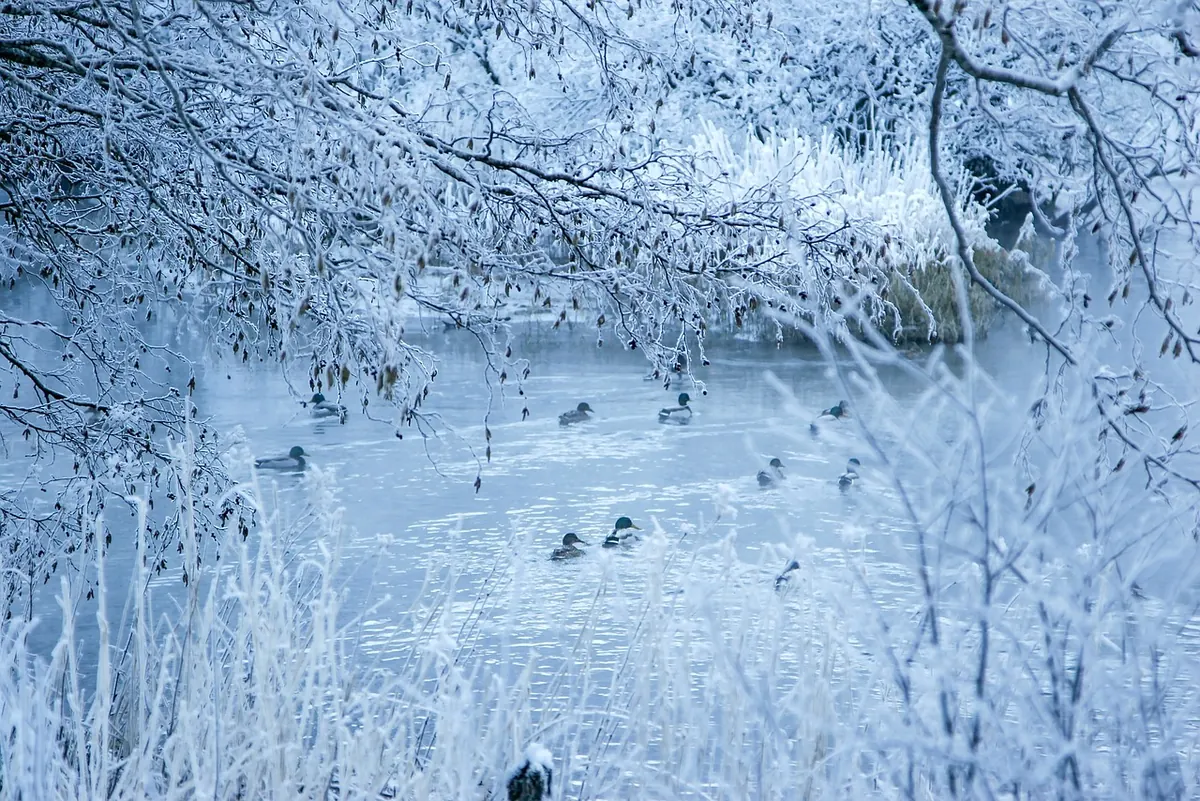
By November the reedbeds have gone quiet and the birds that remain look nothing like the pictures in a summer field guide. Drake mallards look like ducks. Waders stand grey and anonymous on the mud. Winter is when identification stops being about colour and starts being about shape, movement and sound — and once your eye adjusts, it is the most satisfying birding of the year.
Eclipse: the moult that hides the drakes
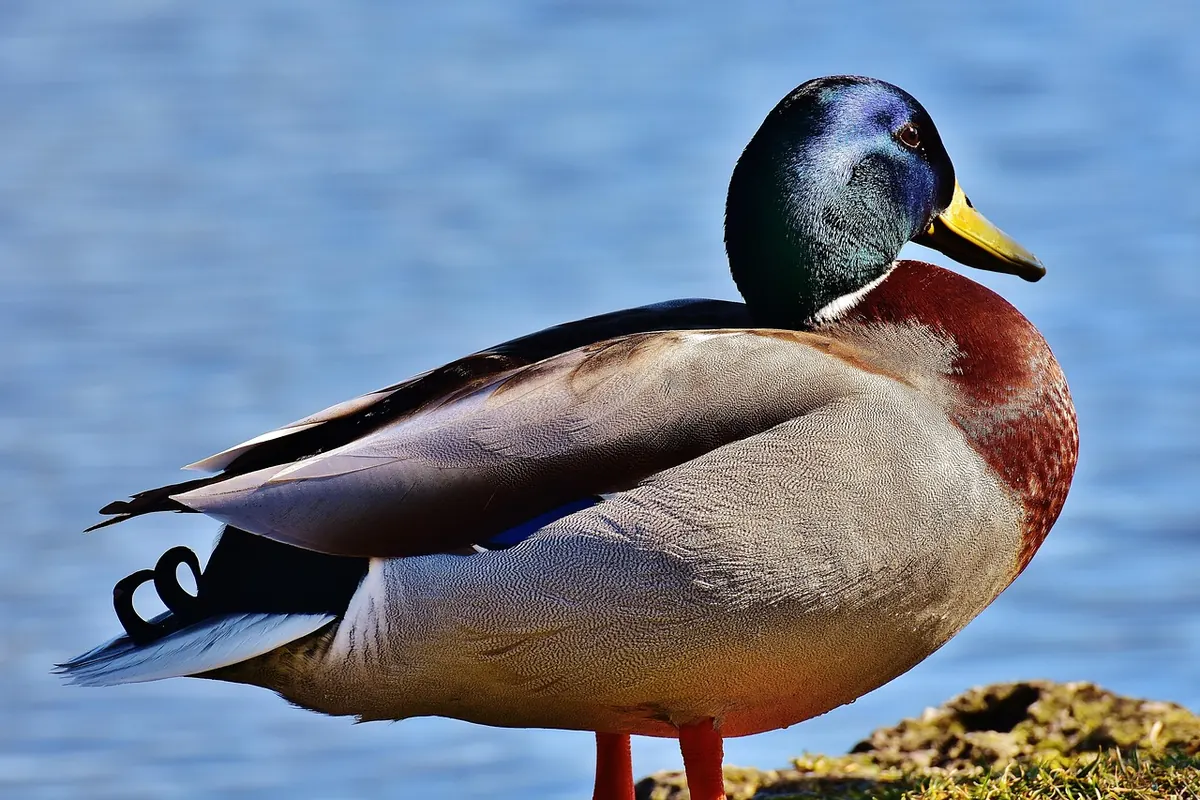
After breeding, drakes of most duck species drop their flight feathers at once and grow a dull, female-like set called eclipse plumage. For a few weeks in late summer they skulk in cover and cannot fly. The wing feathers return first; the body colours come back gradually through a partial moult in late autumn and winter. That is why a drake mallard in December looks settled and handsome, while a drake mallard in September can look like a species you have never seen before.
Diving ducks are more straightforward. Tufted duck, pochard, goldeneye and the sawbills arrive here in full or near-full plumage, so a winter reservoir is often the easiest place to study their colours properly.
Reading the mallard family
Mallard is the best species to practise on, because an eclipse drake keeps three clues.
- Bill: the drake's is yellow-ochre with no dark saddle along the top. The female's is orange-brown with a dark centre.
- Breast: a hint of chestnut still shows, especially in decent light.
- Build: even in eclipse the drake is barrel-chested and thicker-necked than the female beside him.
Teal behave in the same way. An eclipse drake is a brown duck with a slightly stronger face pattern, and the moment the moult completes he shows the horizontal white shoulder stripe that no female has. Wigeon drakes rarely lose the rust-red head and creamy forehead, so they are easy from October onwards. Shovelers keep the enormous bill and often a yellow eye, and both sexes flash a pale blue forewing panel in flight — a useful winter clue, since the speculum of most other ducks reads as dark.
Two more dabbling drakes are worth checking in December. Pintail keeps the needle-pointed tail and white breast stripe through the eclipse, and gadwall — a quietly grey bird — can look almost plain until a curl of black tail feathers and a chestnut wing patch catch the light.
Waders: from breeding finery to plain grey
Waders do it differently. Adults moult into non-breeding plumage on staging grounds or on the wintering estuaries, losing the rufous, black and gold spangles of the tundra. By midwinter an adult dunlin is grey-brown above and pale below, with only a faint breast line where the black belly patch used to be. Knot turn from brick-red to ash-grey. Male ruff, which in summer wears a collar of feathers in almost any colour, becomes a plain bird with a pale head and dark breast patches — still noticeably bigger than the females feeding nearby.
Juveniles are the wildcard. Young waders of the year carry neatly fringed, scalloped feathers across the back, which gives them a fresh, patterned look well into autumn. A juvenile dunlin, knot or ruff is far easier to pick out in October than in December, when wear has evened everything out. If you are learning, go early in the season and work on juveniles first.
Structure first, colour second
Plain plumage makes structure the reliable language. Work through the same short routine on every bird and the flock starts to separate itself.
- Size: judge against a familiar bird standing nearby — mallard, oystercatcher, redshank.
- Bill: length, curve and depth. Curlew's is long and evenly curved; whimbrel's is shorter and kinked, with dark crown stripes behind it.
- Legs: length and colour. Redshank's are orange-red, greenshank's greenish, knot's short and greenish, dunlin's black.
- Posture and action: does it probe deep with a stitching motion, sweep the surface, or run and stop?
- Call: one note often settles it. Redshank's ringing teu-teu and curlew's rising cur-lee carry well across a windy estuary.
Flight is the final check, and godwits are the classic example: black-tailed shows a bold white wingbar and a black tail band, while bar-tailed shows a pale rump and barred tail. Learn one or two of these marks and mixed flocks become far less daunting.
Light, tide and a notebook
Winter light is unkind. Colour washes out under grey cloud, and a low sun behind the birds turns everything to silhouette. Use that rather than fighting it: look at contrast. How dark is the back against a pale flank? Is there a white patch at the rear of the duck? Is the belly whiter than the water behind it?
Tide matters more than optics. On an estuary, the hours around high water push waders onto roosts and into reach; at low water they spread across miles of mud. A reservoir or gravel pit is easier still, because the birds have nowhere to go. Approach with the wind behind you, keep low along the bank, and let a flock settle before you walk through it.
A winter round to practise on
Choose one local wetland and visit it at the same state of tide every few weeks from November to February. Start with the four ducks you can name at a glance — mallard, teal, wigeon, tufted duck — and use them as measuring sticks for everything else that turns up. Then pick one wader a month: dunlin, redshank, curlew, knot. Sketch it, describe the bill and leg colour in your own words, write down the call, and check your notes before you reach for a guide.
By February you will have seen the same birds in early winter, in hard-weather dress and in the first stirrings of pre-breeding moult. A brown duck in December becoming a green-headed drake in March is the whole point of winter plumage — learn it once, and every cold, grey visit to a wetland afterwards has something worth finding.
Photo: StockSnap / Pixabay
Related posts
More stories you’ll love reading